



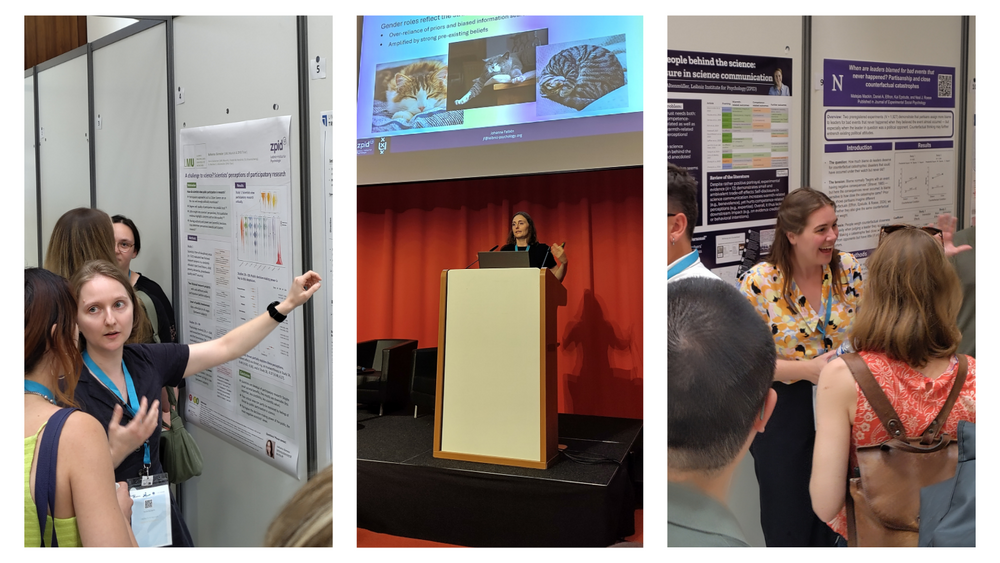
Zehn Forschende des Leibniz-Instituts für Psychologie (ZPID) besuchten vergangene Woche das 20. General Meeting der European Association of Social Psychology (EASP) 2026 in Straßburg. In mehreren Vorträgen und Posterpräsentationen teilten sie ihre Arbeit mit der internationalen Forschungsgemeinschaft. Das ZPID stellte unter anderem Projekte vor, die sich damit beschäftigen, wem Menschen vertrauen und wie sie soziale Informationen bewerten. Marlene Altenmüller, Leiterin des Science Reception Lab am ZPID, blickt auf eine erfolgreiche Tagung zurück: “Das ZPID war dieses Jahr mit geballter Forschungsenergie bei der EASP vertreten! Toll zu sehen, wie viel positives Feedback unsere Arbeit auf der internationalen Bühne erhalten hat. Wir haben viel Inspiration und Motivation aus dem Austausch mit der Community mitgenommen!”
Beiträge des ZPIDs bei der EASP 2026
- Kai Sassenberg: Plausible and implausible conspiracy theories correlate with support for non-normative collective action (Talk)
- Svenja Frenzel: Drawn to the outlaws? The interplay of social exclusion and conspiracy beliefs in predicting trust (Talk)
- André Bittermann: A computational psychology of science approach to social influence (Blitz Talk)
- Marlene Altenmüller: The people behind the science: Self-disclosure in science communication (Poster) und Art about the holocaust: Does aestheticization help or hinder remembrance? (Talk bei der Preconference “Collective Memory”)
- Whitney Agunyego: Don't you, forget about me: Epistemic injustice leads to lower trust in science (Blitz Talk) und Remembering the recent - How remembrance of right-wing extremism affects justice concerns, desired closure, and trust (Talk bei der Preconference “Collective Memory”)
- Lena Zohm: Expert trespassing: Do you know what you are talking about? (Talk)
- Johanna Falbén: Seeing beliefs: Gender-based expectations determine how social information is collected and interpreted (Blitz Talk)
- Lena Hahn: From pre-decisional mental simulation to post-decisional conflict: Prefactual thoughts influence feeling torn and confidence after the decision (Poster)
- Sarah Müller: The expanded Moral Foundations Vignettes (eMFV): A combinatorial, normed stimulus database of moral and immoral scenarios based on moral foundation theory (Talk)